Feature for Dialogue Magazine's debut issue profiling Ciao Bella, a Prospect Lefferts Gardens café founded by Marco and Jessica. The story explores how a neighborhood shop born at the height of the COVID-19 pandemic redefined community, coffee, and belonging in Brooklyn.
Visit Dialogue Magazine ↗Why This Story
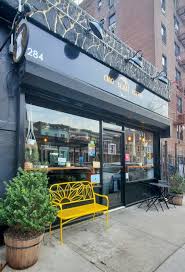
When Dialogue launched its first issue, I wanted to contribute a piece rooted as much in community as in coffee. Ciao Bella first came onto my radar through a friend (who I later quoted in the piece) who had lived in Prospect Lefferts Gardens (PLG) much longer than I had - I had only just moved into the neighborhood. When I eventually visited, looking for a café to highlight, I sat for a while and watched the flow of the space: the interior, the barista-customer exchanges, the way people settled in. I tried the coffee, and by chance I met the owners, Marco and Jessica. Putting together their presence with the place they had built, I recognized something that felt true to Brooklyn and to PLG in particular.
PLG is at its heart a Caribbean neighborhood, and Ciao Bella managed to create a café that did not exclude that community by chasing trends or distancing itself from its surroundings. There are plenty of other cafés within walking distance, but this one seemed to bridge two currents: the newer wave of modern, style-conscious coffee culture, and the rootedness of the neighborhood it belonged to. After interviewing Marco and Jessica and learning how they had opened right at the edge of the COVID-19 lockdowns, and how they adapted with grit and community support, I was certain I had chosen the right story. Instead of abandoning their vision, they reshaped it into something more resilient. That persistence, that insistence on community even under pressure, is what made me want to tell their story.
My Approach
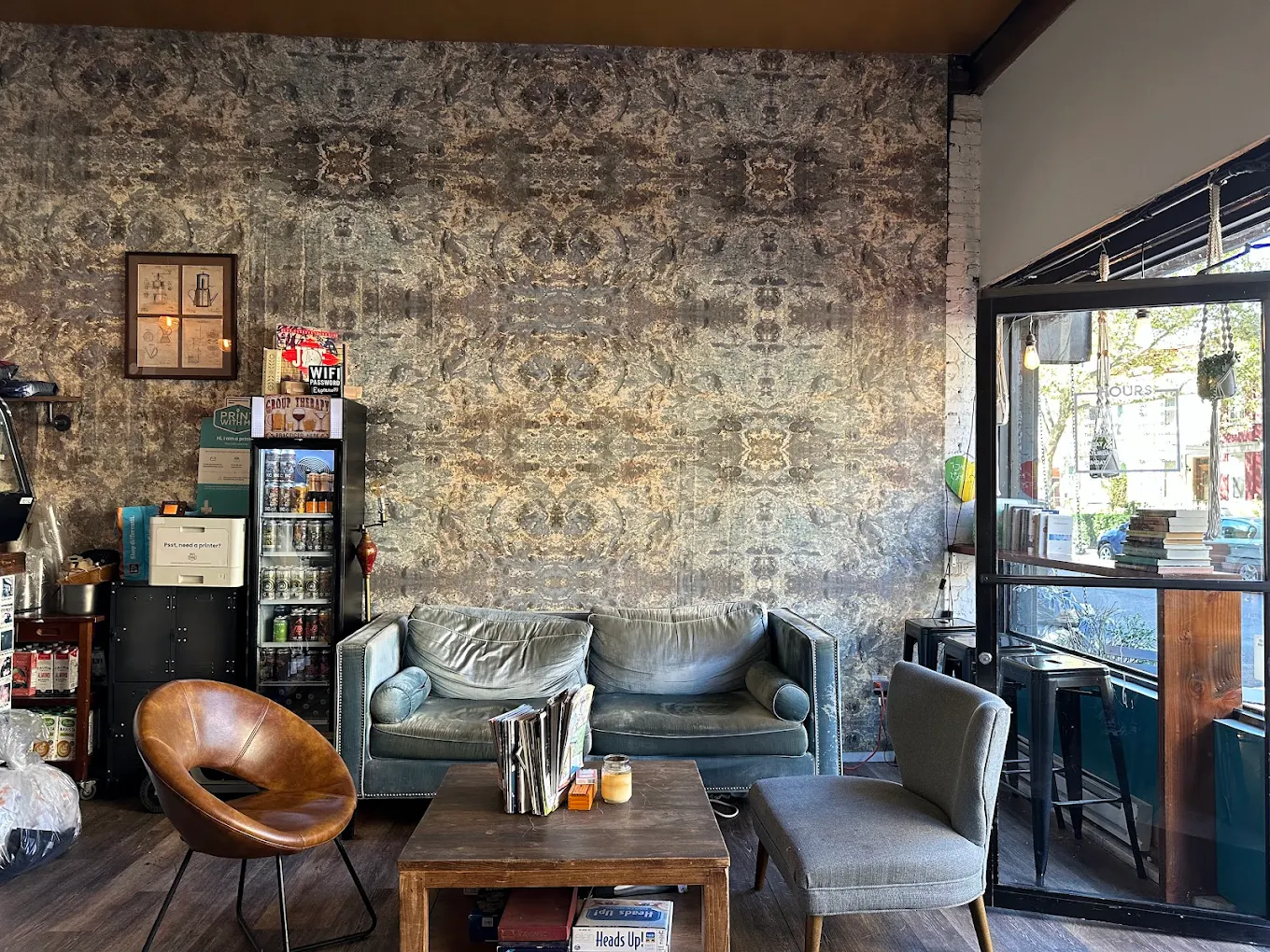
I knew from the start that the piece had to begin with atmosphere. My first visits to Ciao Bella left me holding onto small sensory anchors that carried the story forward: the sound of shots being pulled, sometimes by Marco himself, the hiss of steam from the steamer-wand, the shelves of records lining the walls with jazz and Caribbean artists, and that oversized blue velvet couch that seemed to both welcome and command attention at the center of the room. These were not just decorative details but signposts of the café's identity, and I wanted readers to enter the space in the same way I did, noticing the texture of it before anything else.
The nut graf built on that entry point and set up the bigger frame. It established Ciao Bella as more than a coffee shop, positioning it as a response to the shrinking number of cafés in Brooklyn where people could genuinely linger. For Marco, who had grown up in a small Swiss town, and for Jessica, who had seen how welcoming a campus café could be, the decision to create a space that encouraged connection was deeply personal. Their backstories and values shaped the choices they made, from the music on the walls to the design of the bar.
The arc of the piece followed this progression: begin with sensory immersion, move into the personal histories that explained why the café took the shape it did, and return to the present, where Ciao Bella had become a steady anchor for neighbors and a deliberate choice for remote workers who walked past other cafés just to sit at that blue sofa.
Execution
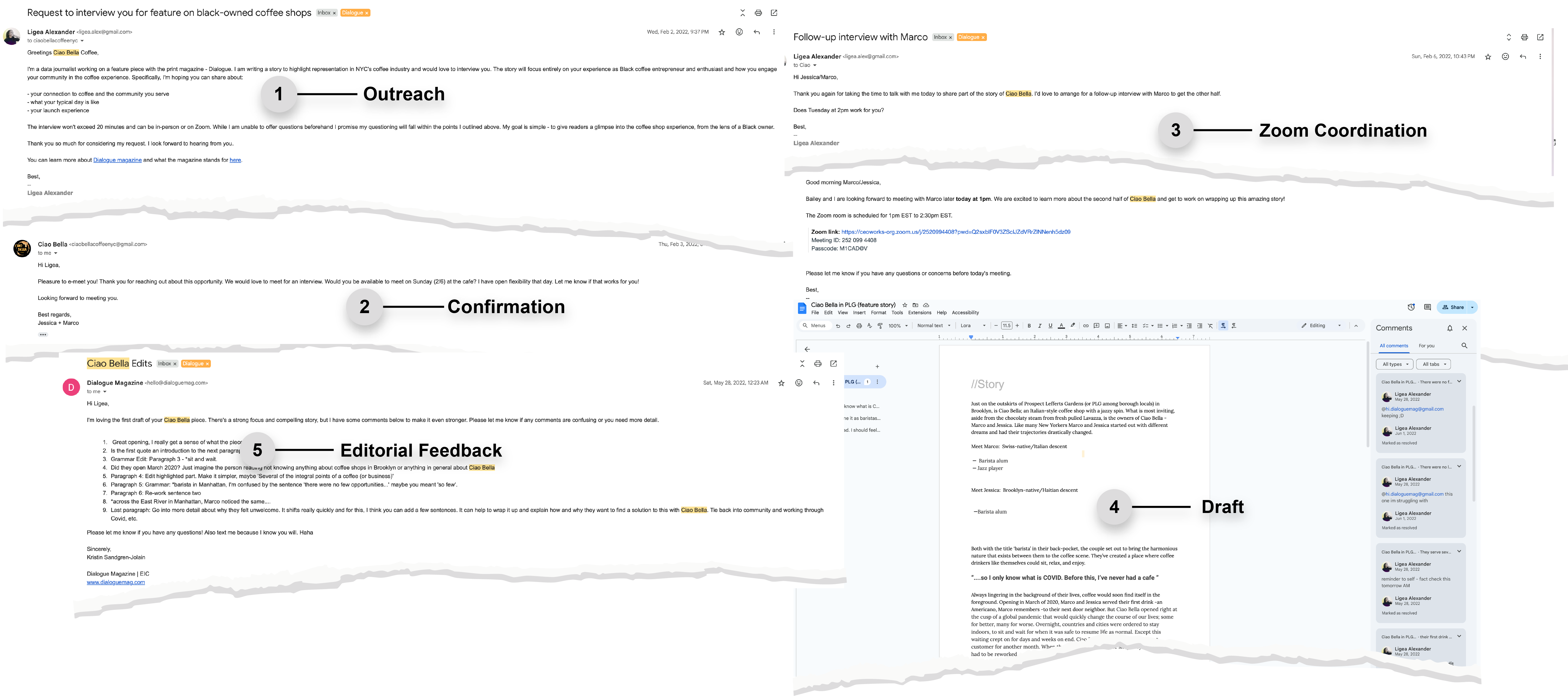
I first reached out to Marco and Jessica in February 2022 and set up a Zoom interview. By then, Ciao Bella had weathered the hardest phases of the pandemic and was slowly becoming an anchor in Prospect Lefferts Gardens. The interview gave me the backstory: how they had opened right before lockdowns, how quickly they had to adapt, and how their different personal histories came together in the café. Marco spoke about the community ties of his small Swiss hometown and the his experiences working as a barista in Manhattan, while Jessica described both the inclusiveness of campus coffee shops she loved and the moments she had felt unwelcome in Brooklyn cafés. Those reflections shaped the emotional core of the piece.
The interview also revealed how much meaning was embedded in small details: the records chosen for the walls, or the bar that Jessica's uncle had built by hand. These touches weren't incidental; they told as much about the café's purpose as any direct statement could. I wanted the narrative to hold both the owners' voices and my own observations, so it felt grounded in lived experience rather than just a retelling of their story.
In drafting, I worked to balance these layers: the intimacy of their story, the atmosphere of the café, and the wider context of Brooklyn's café culture at that moment. Editing meant finding the right pace, so the piece didn't linger too long on any single thread but gave readers enough to feel why Ciao Bella mattered to its neighborhood.
Design, Collaboration & Production
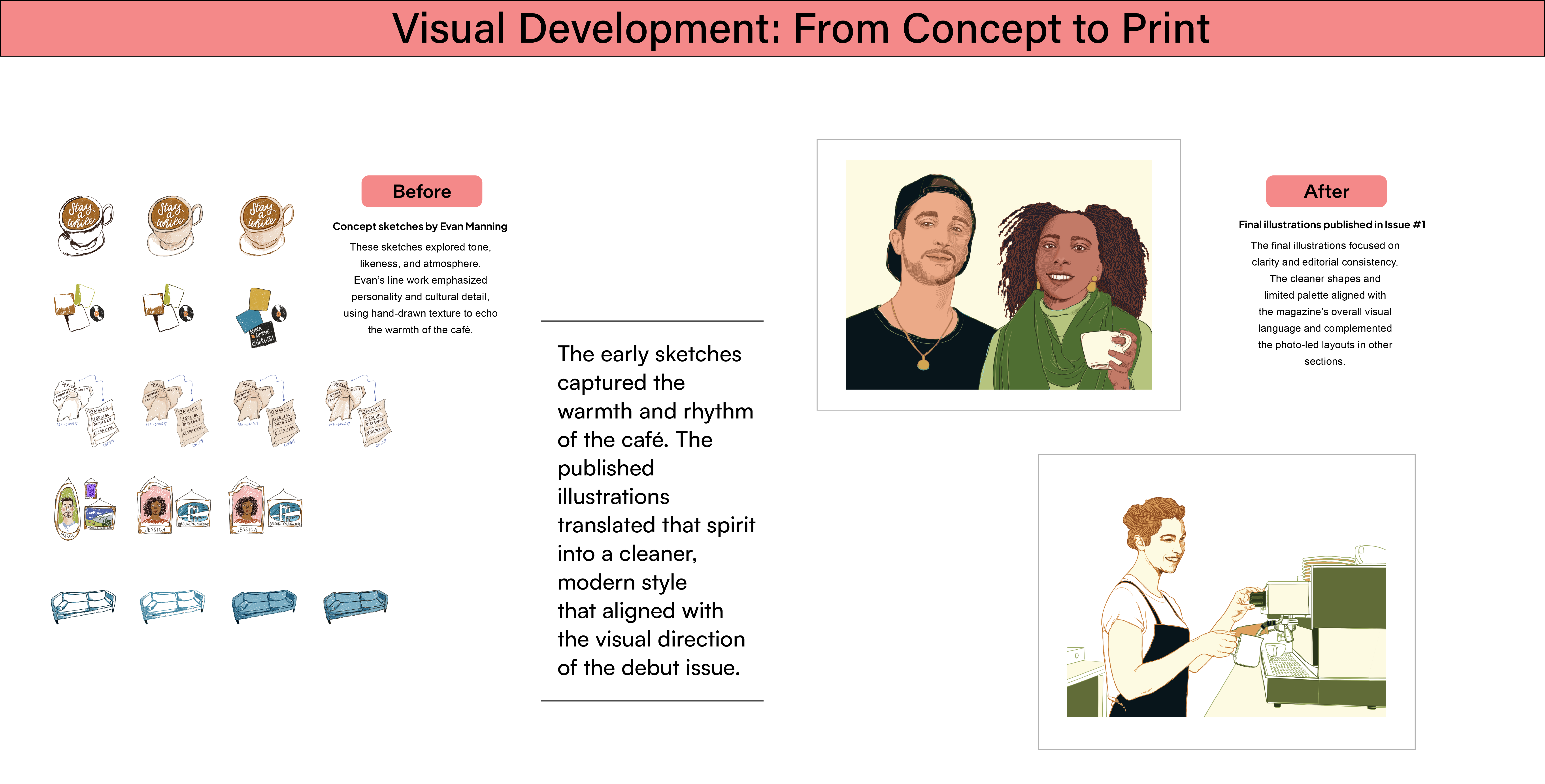
From the beginning I imagined Ciao Bella paired with illustration rather than photography. I asked my MICA classmate at the time, Evan Manning, to experiment with line drawings that would carry the same qualities I noticed in the café: the wide blue velvet sofa at the center, the rhythm of the records on the walls, and the likeness of Marco and Jessica themselves. What I wanted was a style that felt contemporary but did not flatten or Europeanize their features, something that acknowledged them as they were while capturing the warmth of the space.
The early sketches focused on those visual anchors that had stayed with me; the couch in particular was the detail that burned into memory, a kind of shorthand for how the café held people. The illustrations translated those anchors into something playful and memorable. In the end, the editor decided to go in a different visual direction, which meant those drawings never ran in print. But that process reminded me how strongly I tie stories to objects and atmosphere, and how visuals can deepen the cues that text sets in motion.
Impact
The feature appeared in the debut issue of Dialogue Magazine, placed at the center of the book. Rather than standing apart, it sat in harmony with the mix of stories, interview pieces, and poems that gave the issue its range. The choice to pair it with illustration rather than photography also created a natural break in the magazine's pacing, offering readers a different visual entry point between the more photo-forward features.
Positioned this way, the Ciao Bella piece carried weight not only as a profile but also as part of the issue's rhythm and design. It showed how an editorial feature could speak to community and atmosphere while also contributing to the flow of the magazine as an object — something that felt cohesive, layered, and intentional from cover to back.